Infineon, CapSense Liquid Level Sensing Shield
- RS庫存編號:
- 124-4179
- 製造零件編號:
- CY8CKIT-022
- 製造商:
- Infineon

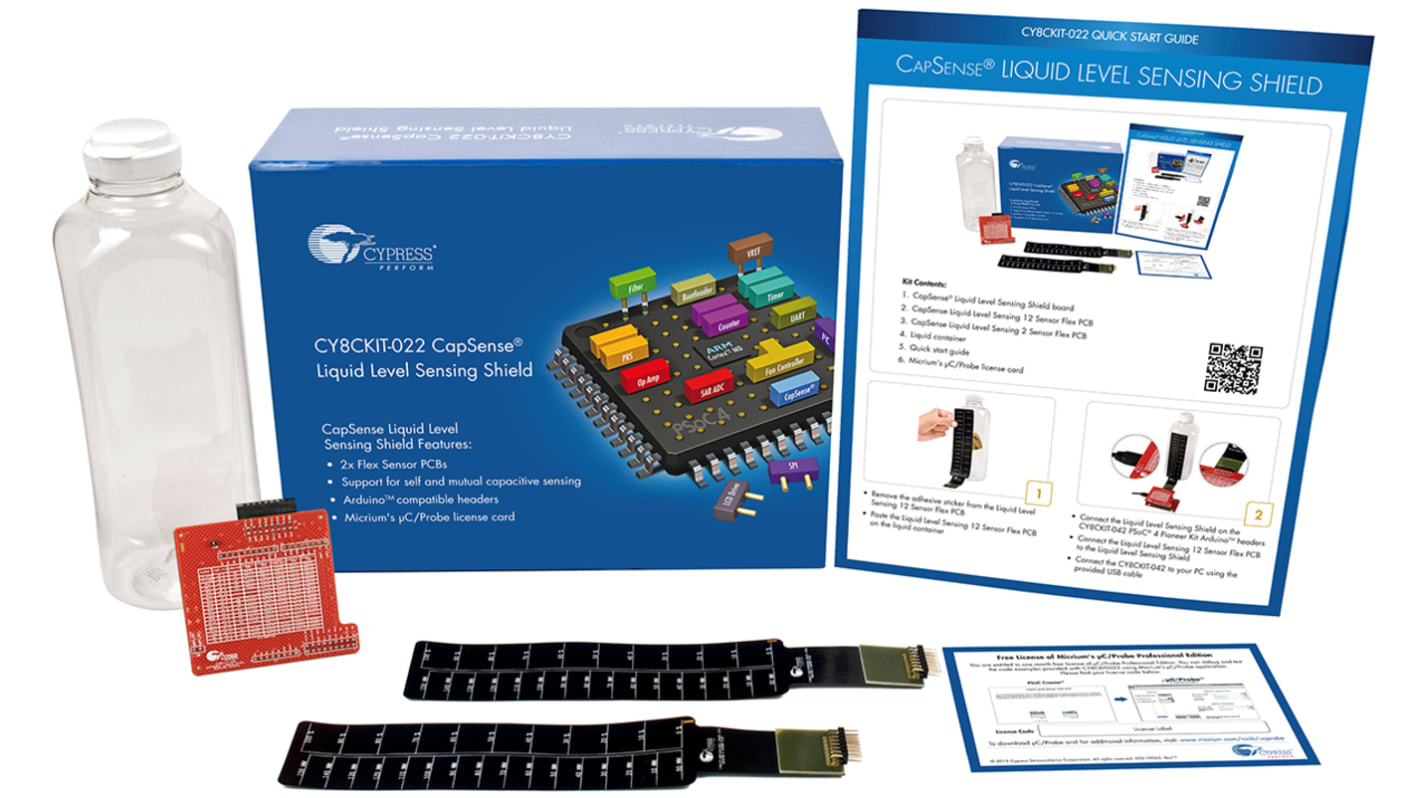
可享批量折扣
小計(1 件)*
TWD2,453.00
(不含稅)
TWD2,575.65
(含稅)
訂單超過 $1,300.00 免費送貨
有限的庫存
- 加上 7 件從 2025年12月15日 起發貨
- 加上 7 件從 2025年12月22日 起發貨
**需要更多嗎?**輸入您需要的數量,然後按一下「查看送貨日期」以查詢更多庫存和送貨詳細資訊。
單位 | 每單位 |
|---|---|
| 1 - 4 | TWD2,453.00 |
| 5 + | TWD2,404.00 |
* 參考價格
- RS庫存編號:
- 124-4179
- 製造零件編號:
- CY8CKIT-022
- 製造商:
- Infineon
規格
產品概覽和技術數據資料表
法例與合規
產品詳細資訊
透過選取一個或多個屬性來查找類似產品。
選取全部 | 屬性 | 值 |
|---|---|---|
| 品牌 | Infineon | |
| Product Name | CapSense Liquid Level Sensing Shield | |
| Kit Classification | Shield | |
| Processor Part Number | CY8CKIT-022 | |
| For Use With | Arduino | |
| 選取全部 | ||
|---|---|---|
品牌 Infineon | ||
Product Name CapSense Liquid Level Sensing Shield | ||
Kit Classification Shield | ||
Processor Part Number CY8CKIT-022 | ||
For Use With Arduino | ||
Infineon Arduino Compatible Shield, CapSense Liquid Level Sensing Shield - CY8CKIT-022
This CapSense Liquid Level Sensing Shield is an Arduino compatible accessory designed for liquid level detection applications. It features a custom board equipped with capacitive sensing technology, allowing for precise measurement of liquid levels. Ideal for prototyping and development, this shield integrates seamlessly with various Arduino platforms, enhancing your electronics projects.
Features & Benefits
• Advanced capacitive sensing technology for accurate measurements
• Supports integration with Arduino platforms for easy development
• Quick start guide simplifies initial setup and usage
• Compact design enables integration in space-constrained projects
• Supports integration with Arduino platforms for easy development
• Quick start guide simplifies initial setup and usage
• Compact design enables integration in space-constrained projects
Applications
• Utilised in liquid level monitoring systems
• Suitable for automation projects requiring fluid detection
• Ideal for development environments focused on sensor technology
• Supports educational projects on capacitive sensing
• Used with the CY8CKIT-042 PSoC 4 Pioneer Kit for expanded functions
• Suitable for automation projects requiring fluid detection
• Ideal for development environments focused on sensor technology
• Supports educational projects on capacitive sensing
• Used with the CY8CKIT-042 PSoC 4 Pioneer Kit for expanded functions
What specific components are included with the shield?
The shield package comprises a CapSense Liquid Level Sensing Shield board, a 12 Sensor Flex PCB, a 2 Sensor Flex PCB, a liquid container, and a quick start guide, providing all necessary components for immediate use.
How does the shield interface with Arduino boards?
The shield features standard mounting provisions that allow it to securely fit onto compatible Arduino boards, enabling straightforward communication between the shield and the Arduino for control and data exchange.
What is the significance of the known issue regarding pin J2?
The issue with J2 Pin 6 being incorrectly labelled does not affect operation since it is not connected to any sensor. Users should ignore this label in their applications while using the shield, ensuring proper functionality without the need for a workaround.
Are there software requirements to operate the shield effectively?
To utilise this shield, it is essential to have PSoC Creator™ 3.3 CP1 or later installed, as it provides the necessary software environment for developing projects with the associated example code for liquid level sensing.
Touch Screen Controllers