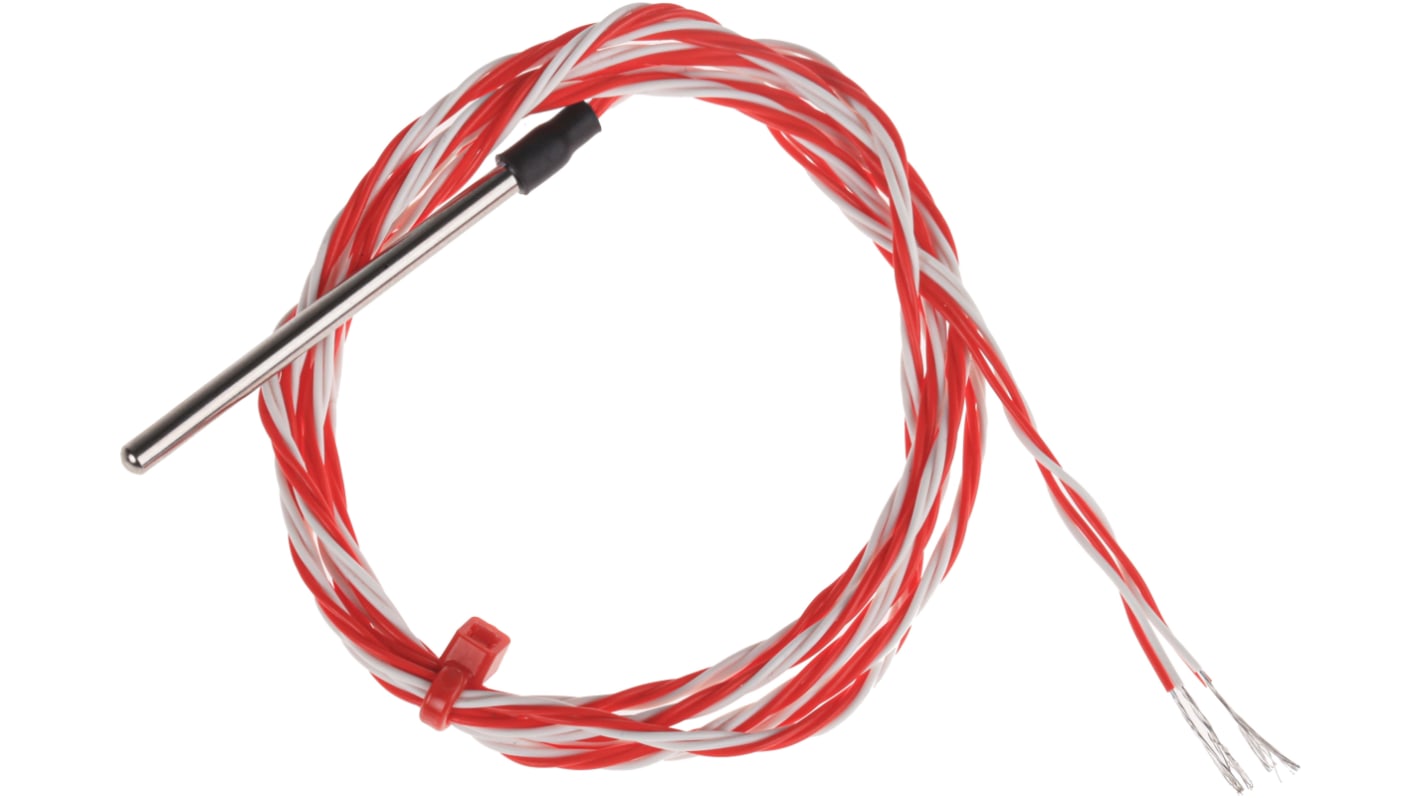
RS PRO PT100 RTD Sensor 3 mm Dia, 50 mm Long, 4 Wire, Class B 200 °C Max
- RS庫存編號:
- 762-1143
- Distrelec 貨號:
- 304-25-873
- 製造商:
- RS PRO

可享批量折扣
小計(1 件)*
TWD1,501.00
(不含稅)
TWD1,576.05
(含稅)
訂單超過 $1,300.00 免費送貨
有庫存
- 57 件準備從其他地點送貨
- 加上 325 件從 2026年6月08日 起發貨
- 加上 325 件從 2026年7月27日 起發貨
**需要更多嗎?**輸入您需要的數量,然後按一下「查看送貨日期」以查詢更多庫存和送貨詳細資訊。
單位 | 每單位 |
|---|---|
| 1 - 4 | TWD1,501.00 |
| 5 - 29 | TWD1,440.00 |
| 30 + | TWD1,185.00 |
* 參考價格
- RS庫存編號:
- 762-1143
- Distrelec 貨號:
- 304-25-873
- 製造商:
- RS PRO
規格
產品概覽和技術數據資料表
法例與合規
產品詳細資訊
透過選取一個或多個屬性來查找類似產品。
選取全部 | 屬性 | 值 |
|---|---|---|
| 品牌 | RS PRO | |
| Product Type | RTD Sensor | |
| Sensor Type | PT100 | |
| Probe Length | 50mm | |
| Probe Diameter | 3mm | |
| Minimum Temperature Sensed | -50°C | |
| Maximum Temperature Sensed | 200°C | |
| Termination Type | Probe | |
| Cable Length | 1m | |
| Probe Material | Stainless Steel | |
| Hazardous Area Certification | NO | |
| Number of Wires | 4 | |
| Accuracy | Class B | |
| 選取全部 | ||
|---|---|---|
品牌 RS PRO | ||
Product Type RTD Sensor | ||
Sensor Type PT100 | ||
Probe Length 50mm | ||
Probe Diameter 3mm | ||
Minimum Temperature Sensed -50°C | ||
Maximum Temperature Sensed 200°C | ||
Termination Type Probe | ||
Cable Length 1m | ||
Probe Material Stainless Steel | ||
Hazardous Area Certification NO | ||
Number of Wires 4 | ||
Accuracy Class B | ||
- COO (Country of Origin):
- GB
RS PRO General Purpose 4 Wire Pt100 PRT Probe with Teflon Insulated Lead
From RS PRO a high-quality and reliable Pt100 PRT (Platinum Resistance Thermometer) or RTD (Resistance Temperature Detector) sensing probe. This RTD probe has a robust construction with the sensing element encased in a rigid 316 stainless steel sheath. The twisted leads are 4 core with a durable and flexible Teflon insulation. This platinum resistance thermometer provides accurate and reliable temperature measurement for a wide range of applications.
What is an RTD?
An RTD is a type of temperature sensor based on the correlation between metals and temperature. As the temperature of a metal increases so does its resistance to the flow of electricity. This resistance can be measured and converted to a temperature reading. In a Pt100 RTD, ’Pt’ stands for platinum (platinum wire or film) and ’100’ means that the temperature sensor has a resistance of 100 Ohms at 0°C. Platinum is the most reliable metal due to its linear resistance to temperature relationship over a large temperature range.
What is a Pt100 Probe?
A Pt100 probe is the most rugged form of RTD. The Pt100 temperature sensor element is mounted inside a metal sheath or probe. This protects it from being damaged by the surrounding environment when it is inserted into the process to be measured. The other end of the probe is terminated by 4 insulated wire tails which are connected to the temperature measuring equipment.
Features and Benefits
• High stability sensing element with a precision output
• IEC 60751 Class B accuracy/tolerance
• Temperature measurement range of -50 to +200°C
• 4 lead wires for accurate readings
• Leads connect to any 2 3 or 4 wire PT100 instrument
• Rigid 316 corrosion resistant stainless steel sheath for protection of sensing element
• Flexible Teflon insulation provides thermal and electrical insulation, impact strength and protects against moisture, corrosion and abrasive chemicals even in extreme temperatures
Applications
These PRT sensor probes with their robust design are ideal for use in many general purpose industrial applications including the following:
• Air conditioning and refrigeration
• Chemical industry
• Plastics processing
• Stoves and grills
• Air, gas and liquid temperature measurement
• Exhaust gas temperature measurement
• Food processing
• Laboratories
Frequently Asked Questions
How Does a PRT Temperature Sensor Work?
The PRT temperature sensor works by placing the sensor element (or process end) into the equipment or process that requires temperature measurement. As the temperature of the platinum resistance thermometer increases it’s resistance to the flow of electricity increases. For every increase per degree of temperature the electrical resistance also changes by a set ratio, this is called the temperature coefficient. For platinum, this ratio is .00385 ohm/ohm/°C which means for a Pt100 with a 100 ohm resistance the increase in resistance per degree of temperature would be 0.385 ohms. The total resistance reading can, therefore, be measured and converted into temperature.
How is the Resistance Measured?
The resistance generated by the temperature sensor is measured by passing current through one of the wires to produce a voltage. This voltage is then measured using a suitable bridge or voltmeter and the resistance calculated in ohms using Ohm’s Law (R=V/I). Once the resistance is known you can convert it to a temperature reading using a calibration equation or a Pt100 table. A temperature measurement device or calibrator can also be connected to the leads of the probe that will automatically convert the measured resistance into a temperature reading
Note
Small Pack Size:762-1143
Large Pack Size:262-3282
Large Pack Size:262-3282
相關連結
- RS PRO PT100 RTD Sensor 4 mm Dia 4 Wire, Class B 200 °C Max
- RS PRO PT100 RTD Sensor 6 mm Dia 4 Wire, Class B 250 °C Max
- RS PRO PT100 RTD Sensor 4.5 mm Dia 4 Wire, Class B 250 °C Max
- RS PRO PT100 RTD Sensor 6 mm Dia 4 Wire, Class B 200 °C Max
- RS PRO PT100 RTD Sensor 4 mm Dia 4 Wire, Class B 200 °C Max
- RS PRO PT100 RTD Sensor 6 mm Dia 4 Wire, Class B 450 °C Max
- RS PRO PT100 RTD Sensor 6 mm Dia 4 Wire, Class B 200 °C Max
- RS PRO PT100 RTD Sensor 4 mm Dia 4 Wire, Class B 200 °C Max